6 Politekhnichna Street
Building 5, floor 8, room 801

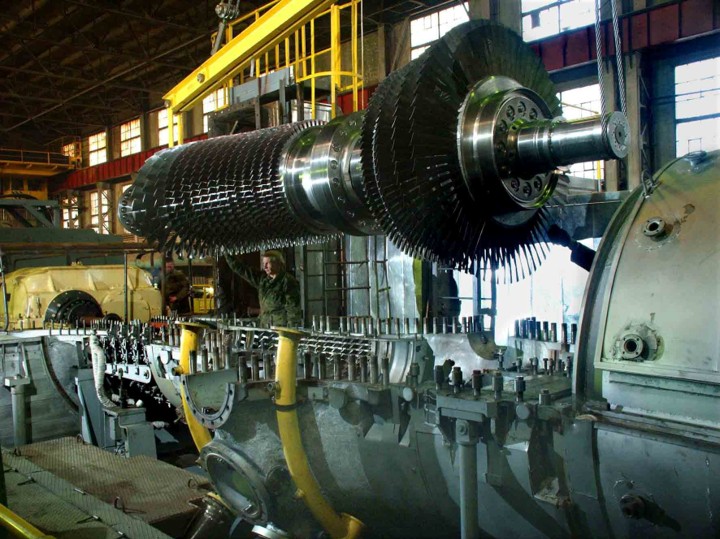
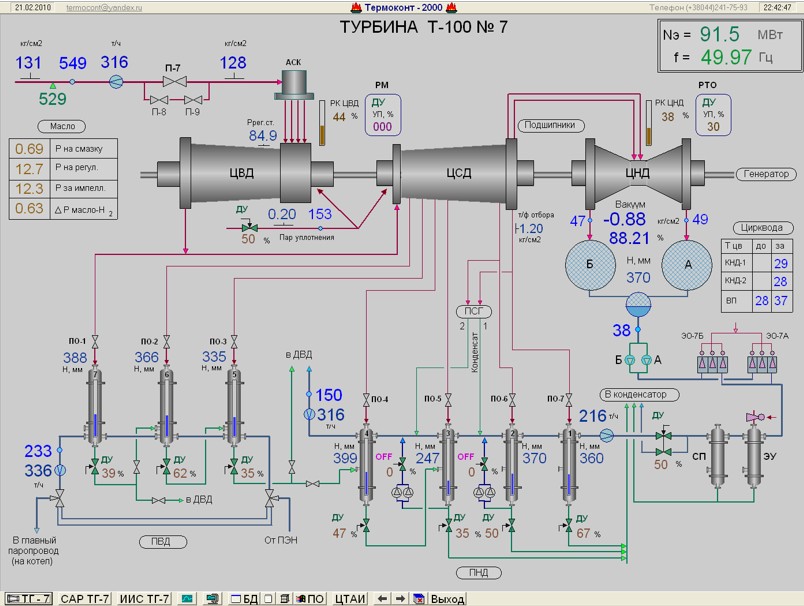
The project covers an automated process-control system for turbine unit 7, identified as model T-100/120-130-2. The system provides continuous monitoring, diagnostics and control, and connects to the combined heat and power plant’s information system over Ethernet.
The project title and control-system description identify turbine unit 7 as model T-100/120-130-2. The general equipment specification names a T-100/120-130-3 condensing turbine with two controlled steam extractions for staged district-water heating. It gives a nominal turbine output of 110 MW at 3,000 rpm and a TVF-120-2 generator rating of 120 MW with hydrogen cooling. The upper extraction pressure range is 0.6–2.5 atm; the lower range is 0.5–2 atm.
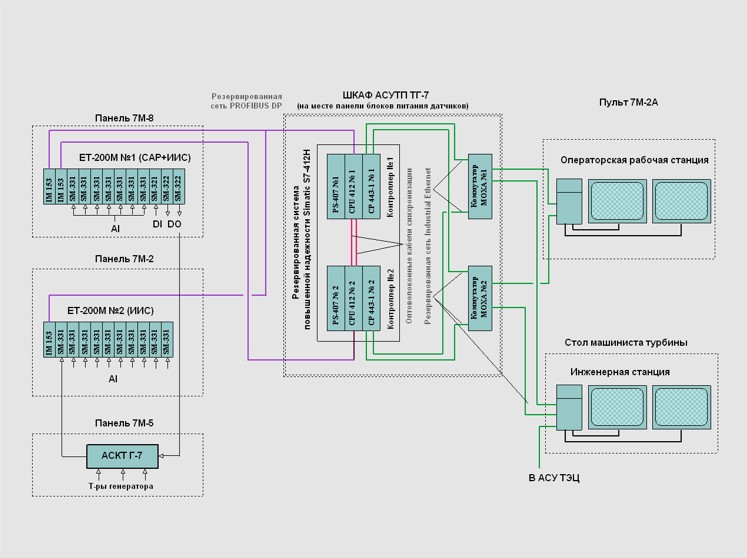
The control system uses two identical Siemens SIMATIC S7-412H industrial controllers operating in a master–standby arrangement. The controllers run the same program and synchronise over optical links. The active controller handles process control and communication with the upper-level system; if it fails, control transfers to the standby controller without a bump, in no more than 30 ms.
Two ET 200M distributed I/O stations connect the system to the equipment. One station supports automatic regulation at panel 7M-8; the other gathers measurement data for the information system at panel 7M-2. Operator and engineering workstations form the upper level. The engineering workstation can monitor and control the process, edit databases and diagrams, adjust controller settings online, archive operating data and provide audible process alarms. It also exchanges data with the plant-wide control system.
The system is designed for year-round operation, with inspections and scheduled maintenance carried out during shutdown periods. Its distributed architecture allows additional intelligent devices or functions to be added to the local network.