6 Politekhnichna Street
Building 5, floor 8, room 801

We teach engineers to connect software with the physical world — from industrial equipment and robots to the energy systems that heat buildings and power communities.
The Department of Automation of Energy Processes (AEP) is part of the Educational and Research Institute of Nuclear and Thermal Energy at Igor Sikorsky Kyiv Polytechnic Institute in Kyiv, Ukraine. Founded in 1958, the department has trained more than 3,000 automation specialists.

We offer bachelor’s, master’s and PhD education in specialty G7: Automation, Computer-Integrated Technologies and Robotics. Teaching connects control engineering with programming, industrial communications and practical work with equipment.
Students learn how to measure what is happening in a process, design a control algorithm, program the equipment and connect it to a wider information system. These skills are used in manufacturing, energy supply, building automation and robotics.
Laboratory work brings the stages together: selecting sensors and controllers, programming local and supervisory systems, exchanging data over industrial networks, and developing supporting web services. The aim is to understand how the whole system works and make well-founded engineering decisions.
Meet our academic staff · Bachelor’s admissions · Master’s admissions
Our partnerships connect teaching and research with the problems engineers solve in industry.
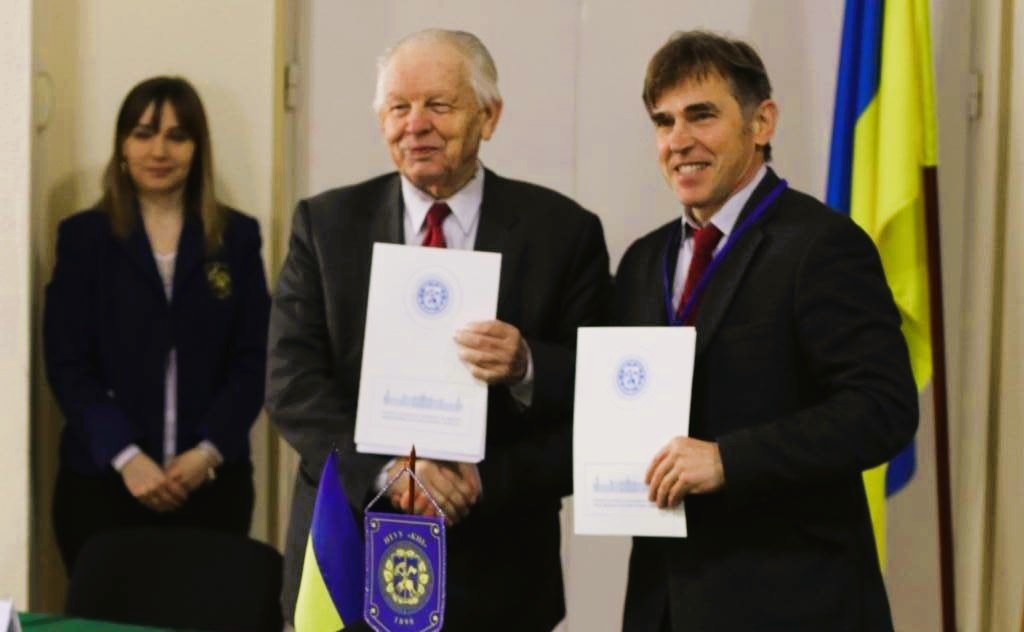
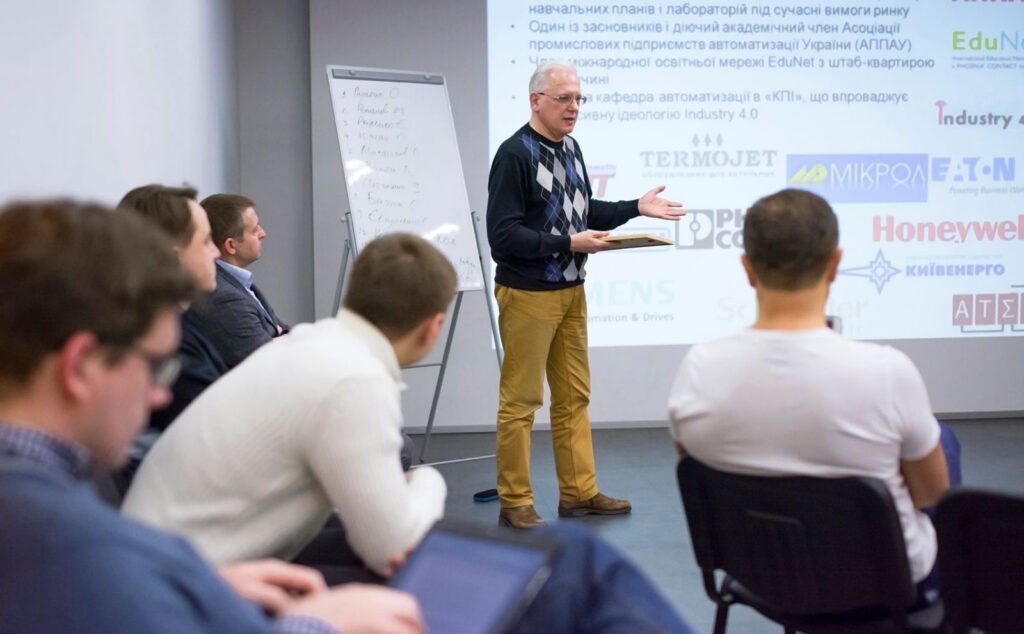
Our laboratories bring together equipment from Ukrainian and international companies, including Phoenix Contact, Schneider Electric, Siemens, Raut-Automatic, Klinkmann, Mikrol and Honeywell.
Students work with industrial controllers, operator interfaces, drives, measuring devices and communication networks. Laboratory activities cover both individual components and their integration into a working automation system. Equipment is also available for student projects.
This gives students a practical setting in which to test ideas, troubleshoot problems and connect classroom theory with real hardware.


Our research combines automatic control with digital technologies to improve the operation of energy systems and buildings. Key areas include the Internet of Things (IoT), cloud computing, machine learning and artificial intelligence.
We also develop digital twins: digital models used to study how physical equipment and systems behave. They help researchers compare operating conditions and investigate ways to improve control and energy efficiency.
Recent research includes:
Over the department’s history, its staff have produced more than 1,100 scientific publications, including monographs, textbooks and teaching manuals.
RoboHUB brings together practical work in robotics, electronics, programming and 3D printing. Its student projects include six-legged walking robots, a balancing rig and a collaborative robot equipped with computer vision.
The examples below show projects by first- and second-year students in 2026. They connect mechanical design, sensors and software in devices that can move and respond to their surroundings.


Interested in studying with us, a student project or a research partnership? Contact the department to discuss the next step.